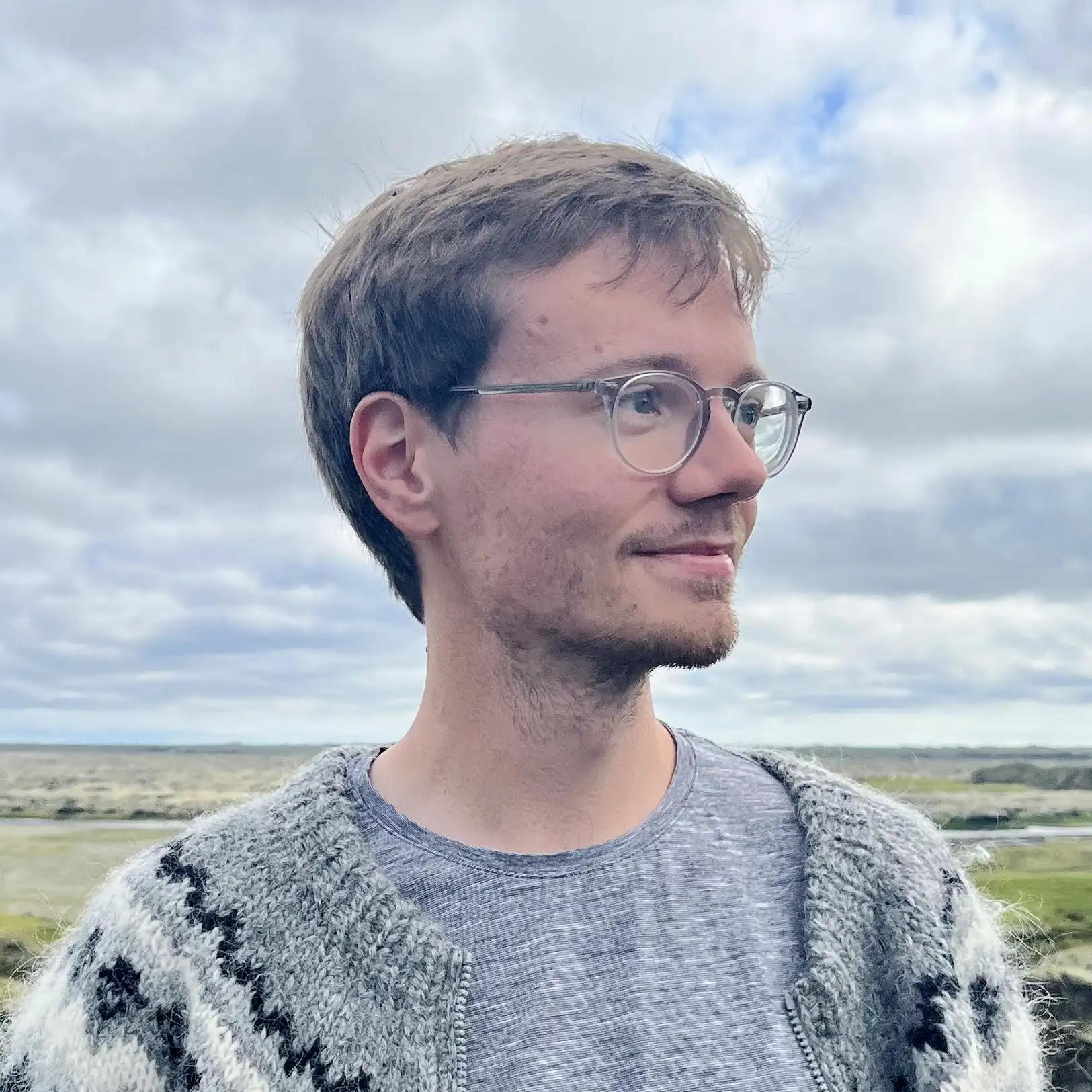
Arinbjörn Kolbeinsson
I study how to make AI systems more controllable,
and apply machine learning to healthcare and law.
Visiting scholar at UVA and researcher at the University of Iceland. Co-founder of K01 and Regava.
Machine Learning Models and Systems
- Model interventions and editing for controllable AI
- 3D neural networks for medical computer vision
- Tensor methods for robust and efficient deep learning
Biomedical & Life Sciences
- Personalised health prediction using multi-modal data
- Molecular simulations and computational drug discovery
- Deep learning for medical imaging and time series
AI & Law
- Dynamic standardisation in legal contracts
- AI governance and regulatory frameworks
- Intersection of law and AI development
At the University of Virginia, I conduct research on Composable Interventions for Language Models, which has been accepted to ICLR 2025.
My work develops frameworks to study how different types of interventions (knowledge editing, model compression, machine unlearning) interact when applied sequentially. With my collaborators, we have uncovered critical insights about intervention interactions and identified gaps in current approaches.
This research aims to enhance model control and efficiency while maintaining performance, with implications for developing more robust multi-objective interventions.
At Evidation Health, I developed machine learning systems for detecting illness from wearable sensor data.
As part of the research team, I built prediction models for FluSmart, a digital flu monitoring program that detects early signs of influenza-like illness. My research advanced the field through self-supervised learning for time series and generative models for wearable data.
In collaboration with the University of Washington, I contributed to Homekit2020, a public benchmark containing over 14 million hours of multimodal health data. This work established new frameworks for temporal health analysis.
This research resulted in patents on self-supervised learning from wearable data and acute illness prediction systems.
During my PhD at Imperial College London, I developed novel deep learning approaches for biomarker discovery from medical imaging and genomic data.
My doctoral research introduced 3D-ResNet architectures for brain MRI analysis, achieving state-of-the-art accuracy in brain age prediction using over 21,000 scans from UK Biobank. Through innovative interpretation methods and phenome-wide association analysis, I identified crucial links between brain structure and systemic health, particularly cardiometabolic and cognitive conditions.
I also developed receptive field networks for analysing genome sequences, demonstrating how deep learning can leverage both local and global genomic structure for polygenic risk prediction.
During my MRes at Imperial College London, I developed computational approaches for drug target characterisation combining molecular simulations with systems biology.
My research integrated molecular docking and dynamics simulations to study protein-ligand interactions, while applying multivariate statistical methods to metabolomics data from GC-MS experiments. I built network models linking metabolites to protein targets through pathway analysis, connecting molecular-level findings to broader biological systems.
My research also focuses on tensor methods for deep learning, making neural networks more robust and efficient.
I developed Tensor Dropout, a novel stochastic regularisation technique that significantly improves model robustness to both random and adversarial noise without requiring adversarial training.
Through collaborations between Samsung AI and Caltech, I contributed to Tensor Regression Networks, demonstrating how tensor methods can reduce parameter count while preserving model expressiveness. These innovations were particularly impactful for medical imaging tasks, enabling more reliable predictions from 3D brain MRI data.
I recently completed legal studies at the University of Iceland, where my thesis research focused on Dynamic Contract Standardisation (thesis in Icelandic) using AI systems.
This work explored how machine learning can make standardised contracts more flexible while maintaining legal validity and protecting consumer rights.
My combined expertise in AI development and law enables me to bridge technical innovation with regulatory frameworks, particularly in areas like contract automation and consumer protection.
-
PhD: Deep learning for health outcome prediction
Imperial College London, 2021 -
MRes in Biomedical Research
Imperial College London, 2016 -
MEng in Bioengineering
Imperial College London, 2015 -
BA in Law
University of Iceland, 2024
- Mike A. Merrill, Alexander G. Shaw, Nicholas Carlini, ... Arinbjörn Kolbeinsson, ... Ludwig Schmidt. "Terminal-Bench: Benchmarking Agents on Hard, Realistic Tasks in Command Line Interfaces". International Conference on Learning Representations (ICLR 2026).
- Arinbjörn Kolbeinsson, Kyle O'Brien, Tianjin Huang, Shanghua Gao, Shiwei Liu, Jonathan Richard Schwarz, Anurag Vaidya, Faisal Mahmood, Marinka Zitnik, Tianlong Chen and Thomas Hartvigsen. "Composable Interventions for Language Models". International Conference on Learning Representations (ICLR 2025).
- Mike A Merrill, Esteban Safranchik, Arinbjörn Kolbeinsson, Piyusha Gade, Ernesto Ramirez, Ludwig Schmidt, Luca Foschini, Tim Althoff. "Homekit2020: A benchmark for time series classification on a large mobile sensing dataset with laboratory tested ground truth of influenza infections". Conference on Health, Inference, and Learning (CHIL) (2023).
- Georgios Efstathiadis, Patrick Emedom-Nnamdi, Arinbjörn Kolbeinsson, Jukka-Pekka Onnela, Junwei Lu. "STASIS: Reinforcement Learning Simulators for Human-Centric Real-World Environments" Trustworthy Machine Learning for Healthcare (2023).
- Arinbjörn Kolbeinsson and Luca Foschini. "Generative models for wearables data." Workshop on Deep Generative Models for Health at NeurIPS (2023).
- Arinbjörn Kolbeinsson, Naman Shukla, Akhil Gupta, Lavanya Marla, and Kartik Yellepeddi. "Galactic Air Improves Ancillary Revenues with Dynamic Personalized Pricing." INFORMS Journal on Applied Analytics (2022).
- Arinbjörn Kolbeinsson, Jean Kossaifi, Yannis Panagakis, Adrian Bulat, Anima Anandkumar, Ioanna Tzoulaki, and Paul Matthews. "Tensor Dropout for Robust Learning," in IEEE Journal of Selected Topics in Signal Processing (2021).
- Akhil Gupta, Lavanya Marla, Ruoyu Sun, Naman Shukla and Arinbjörn Kolbeinsson. "PenDer: Incorporating Shape Constraints via Penalized Derivatives". In Proceedings of the AAAI Conference on Artificial Intelligence (2021).
- Arinbjörn Kolbeinsson, Sarah Filippi, Yannis Panagakis, Paul M. Matthews, Paul Elliott, Abbas Dehghan, and Ioanna Tzoulaki. "Accelerated MRI-predicted brain ageing and its associations with cardiometabolic and brain disorders." Scientific Reports 10, no. 1 (2020).
- Kossaifi, Jean, Zachary C. Lipton, Arinbjörn Kolbeinsson, Aran Khanna, Tommaso Furlanello, and Anima Anandkumar. "Tensor regression networks." Journal of Machine Learning Research 21, no. 123 (2020).
- See all on my Google Scholar profile. Download BibTeX.
Personal explorations and experimental projects where I combine creativity with code.
European Train Journeys
Personal travel log of long-distance train routes I've taken across Europe, visualised on an interactive map with animated route tracing.
Hyper-local Time
Location-based solar time display that adjusts to your exact position on Earth, showing true hyper-local solar time with dynamic backgrounds.
View TimeReference Checker
Validate BibTeX references against CrossRef, Semantic Scholar and arXiv. Catches year mismatches, author discrepancies and missing entries.
Check ReferencesI'm always open to research collaborations, consulting and interesting conversations.
Reach me at arinbjorn@virginia.edu (or book a time to chat), or connect on Bluesky, Threads, LinkedIn or GitHub.